

Kontakt
Prof. Dr. Christian Papilloud (Sprecher)
Telefon: +49 345 55 24251
Telefon: +49 345 55 24250
christian.papilloud@soziolo...
Raum E.58.0
Emil-Abderhalden-Str. 26–27
06099 Halle (Saale)

Gesellschaft und Kultur in Bewegung (GKB)
Leitbild
Leitmotiv unserer Arbeit ist es, Bewegungen bzw. Iterationen gesellschaftlicher und kultureller Prozesse und Akteure im Hinblick auf ihre Bedeutung für sich wandelnde gesellschaftliche Figurationen zu verstehen. Dabei sind wir den Maßstäben moderner Wissenschaftlichkeit verpflichtet. Wir wollen:
- zum Verständnis von Menschen, Ideen, Artefakten und Modellen in internationalen zeitgenössischen und historischen Kontexten beitragen;
- die internationale wissenschaftliche Debatte mitgestalten;
- den wissenschaftlichen Nachwuchs fördern.
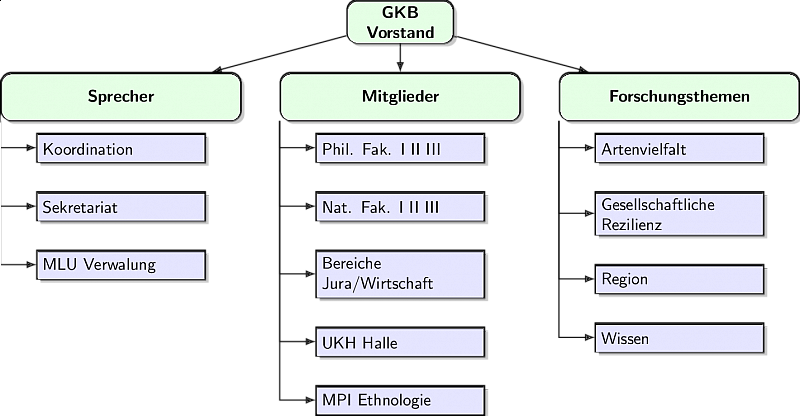
Organigramm des GKB
Entstehung
Gesellschaft und Kultur in Bewegung (GKB) ist als Landesforschungsschwerpunkt mit einer Graduiertenschule 2008 aus dem Graduiertenschule Asien und Afrika in globalen Bezugssystemen hervorgegangen.
Seither entwickelte sich GKB als Universitätsforschungschwerpunkt für die Unterstützung und Profilierung von Verbundforschungsprojekten an der Schnittstelle der Geistes- und Sozialwissenschaften und der Naturwissenschaften in ihrer globalen Vernetzung. Zudem ist GKB eine gemeinsame Unternehmung mit dem Max Planck Institut für ethnologische Forschung .
Seit 2013 organisiert GKB die ANTON WILHELM AMO LECTURES in Erinnerung an den ersten aus Afrika stammenden Wissenschaftler und Philosoph an der Universität Halle und in Deutschland überhaupt.
Lageplan, Anreise
Den Hauptbahnhof Halle (Saale) beim Hauptausgang vorbei am DB-Reisezentrum verlassen, an den Taxis links entlang bis zur Straßenbahnhaltestelle.
Mit den Straßenbahn-Linien (7,12) Richtung "Reileck" fahren.
Die Straßenbahn braucht ca. 18 Minuten bis zur Haltestelle "Reileck". Ab Reileck zu Fuß auf Richard-Wagner-Str. Richtung "Landesmuseum für Vorgeschichte" gehen. Vor dem Landesmuseum rechts gibt es einen Park mit einem Spielplatz -- durch den Park zur Karl-Liebknecht-Str. gehen. Dort auf die Reichardtstr. bis zur Nr. 6 gehen.
Fahrkarten sind am Automaten an der Haltestelle erhältlich, manchmal auch mit Geldkarte an den Automaten im Fahrzeug.
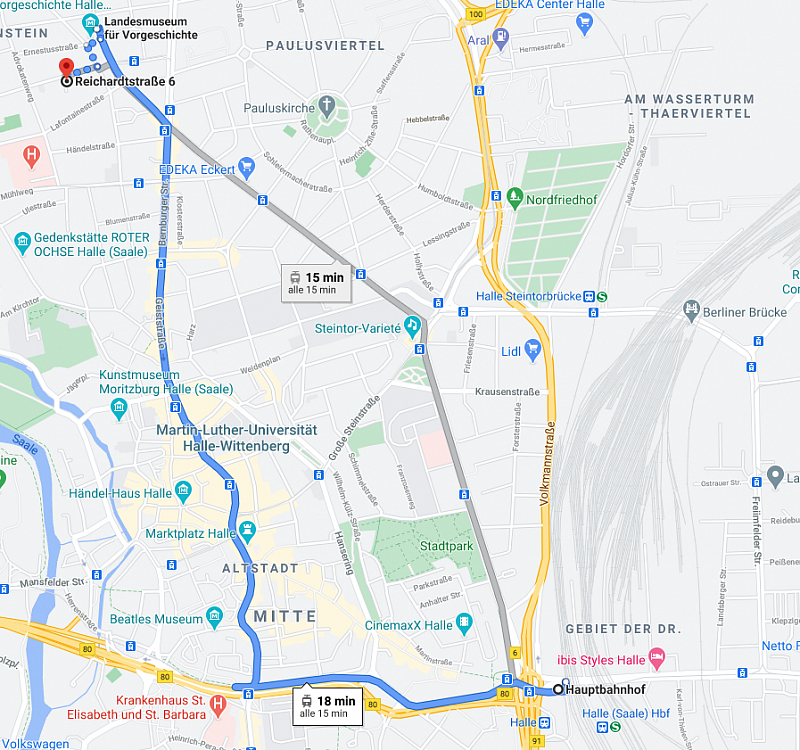
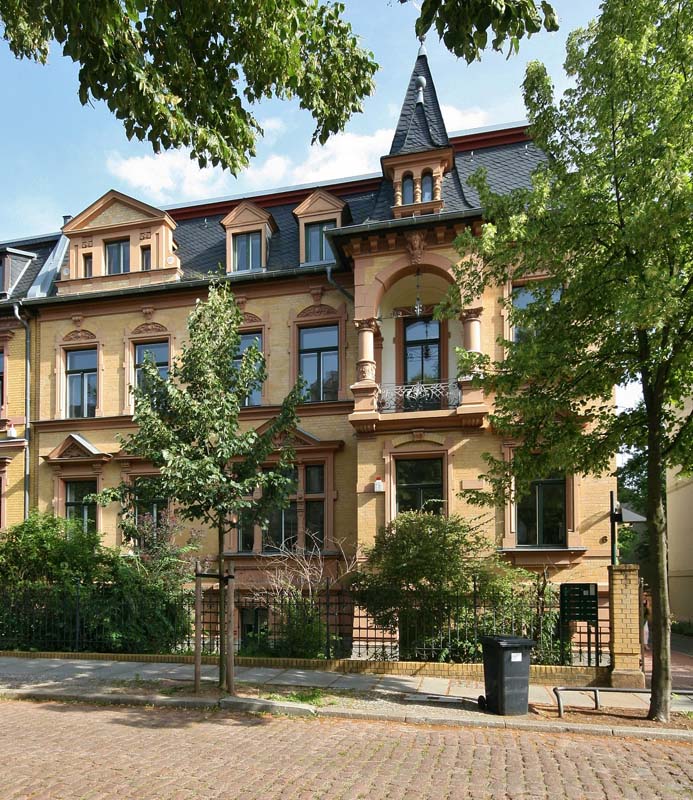
Weg zum Gebäude des Landesforschungsschwerpunktes
Verwandte Institutionen
Universitätsschwerpunkt Aufklärung -- Religion -- Wissen